Stripe Press — a catalogue composed from book spines
Dark Premium · full website
Source: pending · Classification: pending
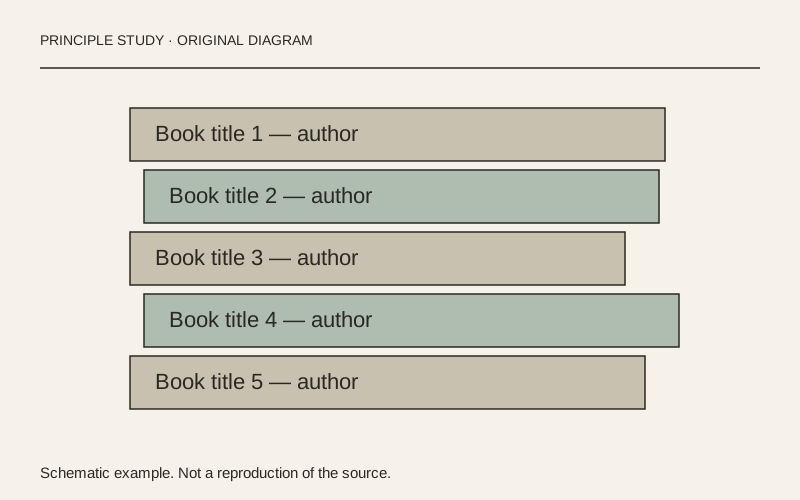
Original principle diagram · Draft explanation
Make the objects form the catalogue.
What to borrow: Use an object's recognizable form to organize a collection while keeping its title visible.
When to use this principle
- When it works
- Small visual catalogues whose products have distinctive physical forms.
- When to avoid it
- Using a visual stack as the only navigation for a large or accessibility-critical catalogue.
Original teaching diagram with illustrative content; not a screenshot or reconstruction of the source. Trova · AI-assisted illustration. Original Trova diagram.
- Steal · grid/layoutmodel draft
The captured catalogue centers a vertical stack of book spines on a dark field, with generous space around the stack. The physical objects become the organizing structure rather than sitting inside a conventional product-card grid.
- Steal · typographymodel draft
The upper-left brand lockup uses serif type, while each book retains its own cover typography. Keep the interface restrained when the collection already contains many visual voices.
- Steal · colormodel draft
Most of the visible color belongs to the book spines against the dark background. Let the objects supply variety while the surrounding interface stays quiet; this observation does not establish keyboard or motion behavior.
Fonts: Ivar Headline, Ivar Text · Original: Stripe Press
private-reference-only
View original ↗Source & usage rights
Original: Stripe Press. Source verification: pending review.
Recorded rights label: private-reference-only. Original work and reproduction rights belong to their owners. A note license does not grant rights to copy a screenshot, trademark or design.
Trova notes: apply the principles in your own work, including commercial projects. Bulk republication or resale is not permitted. Usage terms.
Captured: 2026-10-10. Capture does not establish source verification.